JPEG Example
A visible image containing a later reconstructable hidden state.
Datamorpho is easiest to understand through concrete examples. Each example should pair a visible carrier with a public manifest, a reconstruction object, and a clearly defined expected output.
Carrier examples
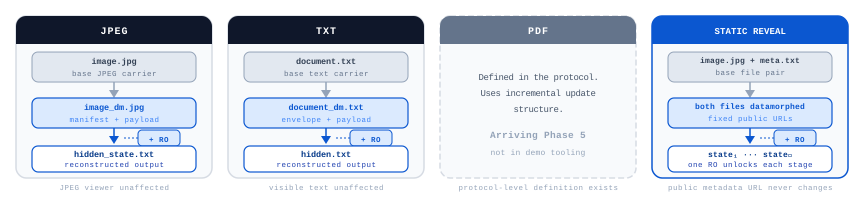
These examples are meant for developers, reviewers, implementers, and anyone trying to understand Datamorpho through practical carrier-specific cases. The first public website demo is intentionally limited to JPEG and TXT, while PDF remains documented at the protocol level.
A visible image containing a later reconstructable hidden state.
A visible text file with a Datamorpho envelope and reconstructable hidden content.
A protocol-level profile example only for now. PDF is documented in the specification but intentionally excluded from the first website demo implementation.
A Datamorphed JPEG and Datamorphed metadata file working together without moving the public metadata location.
Why examples matter
In Datamorpho, examples serve technical purposes. They are not just demos. They help explain carrier semantics, reveal edge cases, test implementations, and make the protocol easier to review in public.
Examples make it easier to understand the difference between public declaration, concealed payload, and reconstruction semantics.
Examples provide stable inputs and expected outputs for early tooling and future interoperability checks.
Examples make it easier for developers, researchers, and reviewers to discuss the protocol with concrete artifacts.
Interoperability
Beyond human-readable examples, Datamorpho should also maintain structured vectors for deterministic validation and future interoperable implementations.
A strong Datamorpho example should help three audiences at once: users learning the concept, developers implementing the protocol, and reviewers trying to validate correctness.
How to use these examples
The examples page is meant to support a simple workflow: understand the carrier, inspect the declaration layer, examine the reconstruction object, and compare the final output with the expected result.
Start with the landing page, then use the examples to understand what a Datamorphed carrier looks like in practice.
Read the specification, inspect the examples, compare the outputs, and use them as fixtures when building or reviewing tooling.
Next examples
JPEG, TXT, and PDF are the first public carrier profiles. Audio and video are the next immediate targets, and future example sets should expand accordingly once the first tooling release is stable.
They are strong demonstrations of early distribution and later reconstruction for media-heavy use cases.
They require more work around size, streaming, re-encoding, and tooling complexity than the first carrier set.