What is standardized
- public declaration of Datamorphosis
- state-specific reconstruction object model
- digest cross-binding
- canonical payload offset semantics
- layout strategy semantics
- JPEG, TXT, and PDF carrier profiles
This document defines the normative structure of Datamorpho v0.001: the public manifest, concealed payload semantics, reconstruction object model, digest binding, and the initial carrier profiles for JPEG, TXT, and PDF.
Scope
Datamorpho v0.001 is the first normative public release of the protocol. It defines the file-level structure and semantics required for interoperable Datamorpho creation and reconstruction, while intentionally leaving many deployment-specific behaviors out of scope.
Datamorpho standardizes the structure of files and reconstruction semantics. It does not attempt to standardize every future viewer, decryption interface, or trigger-verification workflow.
Core model
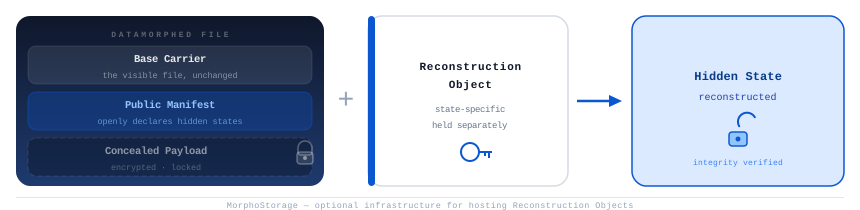
Datamorpho organizes a file into clear protocol layers so implementations can reason about discoverability, hidden bytes, and reconstruction without ambiguity.
The original visible file that remains valid in its native format.
The declared metadata layer that identifies states, triggers, MorphoStorage, and reconstruction digests.
The byte region or regions from which hidden states may later be reconstructed.
The state-specific secret-bearing object that provides fragment map, key material, and reconstruction instructions.
Carrier profiles
Version 0.001 begins with JPEG, TXT, and PDF. These provide a practical starting point across image, text, and structured document carriers.
jpeg-trailerA valid JPEG image followed by a Datamorpho Binary Block appended after the final end-of-image marker.
txt-envelopeA visible text file followed by a terminal Datamorpho envelope containing the public manifest and encoded payload.
pdf-incrementalA valid PDF followed by Datamorpho objects and payload streams appended through an incremental-update section.

Public declaration
Datamorpho is not steganography. The standard requires a public declaration that hidden states exist and where reconstruction information may later be found.
The public manifest identifies the Datamorpho version, manifest type, carrier, profile, and the declared set of hidden states.
Each state descriptor identifies a state_id, its declared triggers, one or more MorphoStorage directions, and the expected reconstruction-object digest.
MorphoStorage is a generalized locator model. It may point to a URI, an IPFS CID, an EVM contract call, a textual instruction, or another implementation-defined retrieval direction.
Reconstruction semantics
In Datamorpho v0.001, the reconstruction object is a complete secret-bearing artifact for one target state. It contains the fragment map, ordering, layout strategy, digest binding, cryptographic information, and key material required to reconstruct that hidden state.
state_idThe reconstruction object is treated as the secret object. If it is already sensitive because it reveals the fragment map and suite instructions, there is no strong architectural reason to forbid it from also carrying the key material needed for reconstruction.
Layout strategy
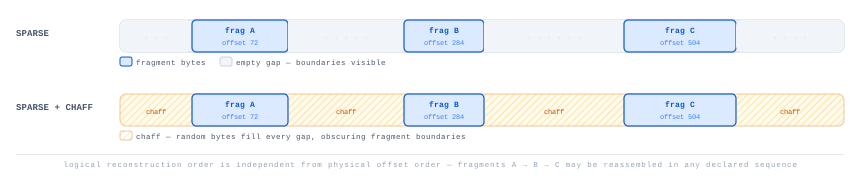
Datamorpho v0.001 standardizes two payload layout strategies so implementations can choose between efficiency and additional ambiguity depending on carrier size, bandwidth, and practical constraints.
sparseMeaningful bytes are non-contiguous and only the referenced spans matter. This option remains useful for very large carriers or environments where payload size, storage, or transfer costs matter significantly.
sparse-with-chaffMeaningful bytes are non-contiguous and unreferenced bytes are intentionally present as ambiguity-increasing material. Those bytes may include chaff, filler, or bytes belonging to other states.
Boundaries
Datamorpho deliberately keeps the core specification focused. It standardizes the structure of multi-state files and reconstruction semantics, but avoids overreaching into every implementation-specific decision.
The standard does not define a universal viewer UX or interpretation flow.
Trigger declaration is standardized, but trigger execution logic is not.
Onchain integrations are possible, but wallet logic and business rules remain implementation-specific.
Review
Datamorpho is an open protocol project. Public review, implementation feedback, examples, and criticism are part of how the standard should mature.
Use the whitepaper for the conceptual rationale, security framing, and long-term project direction.
Specification work, tooling, examples, and project structure live in the public repository.
Questions, proposals, and design discussion should happen in public and remain easy to review.