What it combines
- public declaration
- concealed payloads
- state-specific reconstruction objects
- cryptographic agility
- sparse and sparse-with-chaff layout
Datamorpho is an open file standard and protocol model for files that remain valid in their original format while also containing one or more sealed hidden states. These hidden states can later be reconstructed through state-specific reconstruction objects.
Datamorpho is not steganography. Hidden states are declared, not denied.
Abstract
Datamorpho is a file standard and protocol model for creating files that preserve an ordinary visible representation while also containing one or more concealed alternate states. These states are not merely appended encrypted blobs, and Datamorpho is not steganography. A Datamorphed file is expected to declare that hidden states exist and to indicate where reconstruction information may later be found, while still withholding the structural and secret material needed to recover those states.
Datamorpho does not claim magical invulnerability. It claims layered resistance: structured composition of cryptography, payload layout, reconstruction secrecy, and digest binding.
Motivation
Traditional files are static. Traditional encrypted files are often monolithic. Traditional reveal patterns frequently require changing the public metadata location. Datamorpho addresses a different need: files that can remain ordinary and valid while also carrying hidden future states that can only be reconstructed later.
Distribute or preserve the carrier first, then release reconstruction later.
Keep the file in place while allowing its reconstructable state to change over time.
Create digital objects that can survive and evolve without replacing the carrier itself.
Model
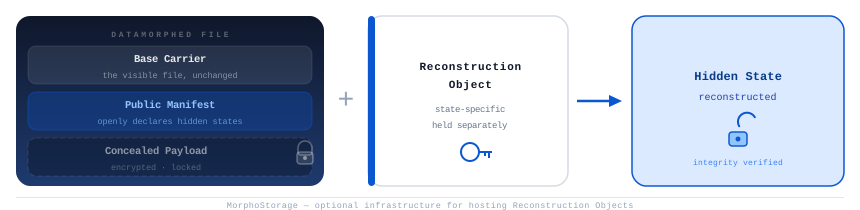
The protocol is easiest to understand as four coordinated layers: a base carrier, a public manifest, a concealed payload, and one or more state-specific reconstruction objects.
The visible file that remains valid and ordinary to standard readers.
The explicit declaration that hidden states exist and where reconstruction may later be found.
The bytes from which hidden states can later be reconstructed.
The secret-bearing artifact that reconstructs one target state.
Security model
Datamorpho’s strength comes from composition. It is strongest when cryptography, sparse layout, optional chaff, non-monotonic fragment ordering, state-specific reconstruction, and digest cross-binding work together.
The reconstruction object is a complete secret-bearing artifact. If it already reveals the fragment map, ordering, and suite instructions, there is no strong architectural reason to prohibit it from also carrying the key material required for reconstruction.
Layout strategy
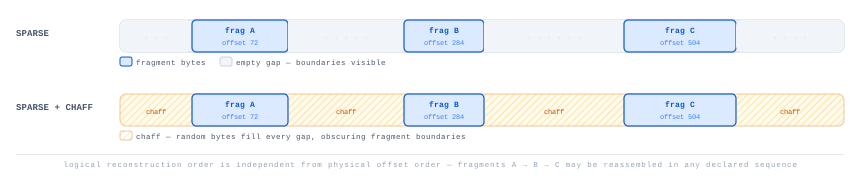
Datamorpho v0.001 standardizes two layout strategies. Both avoid a single obvious monolithic hidden object, but they optimize for different practical constraints.
Useful when a creator wants non-contiguous hidden spans without paying the storage or transfer cost of additional chaff. This can matter for very large files and bandwidth-sensitive environments.
Useful when additional ambiguity matters. Unreferenced bytes may be filler, chaff, or bytes belonging to other states, increasing the cost of naïve extraction.
Use cases
Datamorpho is broader than any one niche. It can support controlled disclosure across media, documents, games, archives, and other digital systems that benefit from early distribution and later reconstruction.
Unlockable items, rewards, lore objects, and latent assets.
Long-lived files whose additional states are reconstructable later.
Reports, certificates, policies, and alternate document states.
State-linked disclosure patterns where some information should emerge later.
Reveal without moving the public metadata location or replacing the carrier file.
Distribute the file broadly first, then release the reconstruction object at the correct time.
Current carriers
Version 0.001 focuses on JPEG, TXT, and PDF. The next immediate targets after the first tooling release are audio and video, where Datamorpho’s distribution-first, reconstruction-later model becomes especially powerful.
They benefit strongly from staged distribution, synchronized reveal, and future-proof handling of media states.
They introduce larger payload sizes, streaming constraints, re-encoding issues, and more demanding implementation work.
Public good
Datamorpho is being developed as a public protocol project: an open specification, an open whitepaper, open-source reference tooling, free examples, and a free public tooling layer through datamorpho.io.
The protocol is publicly documented and discussable.
Python and JavaScript tooling are intended to remain collaboration-friendly and reusable.
Datamorpho.io is intended to offer free create and reconstruct flows, plus an optional MorphoStorage helper that the protocol never depends on.
Origin
Datamorpho’s public origin traces back to an early prototype showcased at ETHGlobal Mexico 2022, where the project appeared as a finalist and already framed the idea of dynamic files and static-location reveal patterns. The present whitepaper and specification are the first formal open protocol releases.
Germán Abal — g@evvm.org
Ben Dumoulin — early PoC implementation support
R. Benson Evans — early PoC research support
Eduardo — early PoC design support
What comes next
Datamorpho is currently in the public specification and first tooling phase. The next steps are practical tooling, browser compatibility, examples, testing, and broader ecosystem feedback.
Freeze the first public protocol release.
Release Python and JavaScript implementations.
Offer free create and reconstruct flows on Datamorpho.io.
Move into audio, video, interoperability, and broader review.