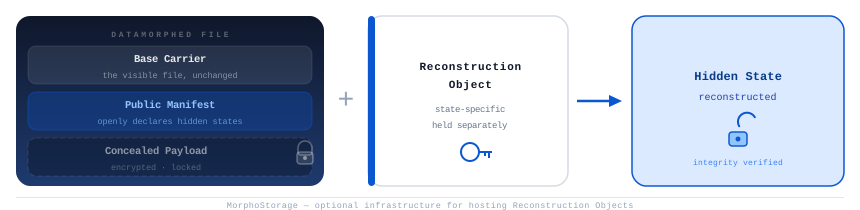
Base Carrier
The ordinary visible file, such as a JPEG, TXT, or PDF.
Datamorpho is an open file standard for files that remain valid in their original format while containing one or more sealed hidden states. Those states can be reconstructed later through state-specific reconstruction objects.
Datamorpho enables staged releases, delayed disclosure, secure distribution, archives, interactive assets, and future-proof digital objects without changing the original carrier file.
Overview
Datamorpho is an open standard for multi-state files.
A Datamorphed file keeps its normal visible form while also containing one or more hidden future states. The file can publicly declare that these hidden states exist, indicate where reconstruction information may later be found, and still keep the actual recovery of those states dependent on a separate secret-bearing reconstruction object.
Datamorpho is not a viewer trick, not a metadata swap pattern, and not steganography. It is a declared latent-state file architecture.
The ordinary visible file, such as a JPEG, TXT, or PDF.
Declares Datamorphosis, hidden states, triggers, and MorphoStorage directions.
The embedded bytes from which one or more hidden states may later be reconstructed.
The state-specific secret-bearing object used to reconstruct one hidden state.
Why it matters
Datamorpho makes files capable of carrying sealed hidden future states without breaking their original format. This enables safer and more flexible digital workflows where distribution and reconstruction do not need to happen at the same time.
Reveal hidden file states only when the correct reconstruction object becomes available.
Distribute media or documents early and reconstruct them later at the correct moment.
Preserve files with latent states for future release, access, or recovery.
Create items, rewards, unlockables, and hidden assets with file-level latent states.
Support information release patterns where some file-linked state should only be reconstructed later.
Spread the carrier file widely first, then release reconstruction material later.
Datamorpho gives files latent states. That is a fundamental new capability.
Current carrier profiles
Datamorpho v0.001 defines JPEG, TXT, and PDF profiles at the protocol level. The first public demo tooling on Datamorpho.io intentionally supports JPEG and TXT only. Audio and video remain the next immediate targets after the first release.
A valid JPEG image followed by a Datamorpho binary block.
A terminal Datamorpho envelope appended after visible text.
Defined in the protocol specification, but intentionally excluded from the first public website demo until a controlled implementation is ready.

Free tools
Many people will come here to create Datamorphed files or reconstruct hidden states. The tooling layer is meant to make Datamorpho accessible while keeping the protocol itself open and inspectable.
Create Datamorphed files from supported carrier formats using public manifests, payload layout strategy, and reconstruction objects.
Load a carrier file and a reconstruction object to reconstruct one hidden state and export the recovered output.
A locator declared in the public manifest, pointing to where a reconstruction object can be found: a URI, an IPFS CID, a contract reference, or plain text instructions. It is defined by the specification and anyone can implement or host it. Datamorpho.io intends to offer an optional hosted helper, but it is never required: the protocol does not depend on it, and fully local workflows need no network call at all.
The first tooling focus is correctness, usability, and protocol alignment: open-source Python tooling first, then browser-compatible JavaScript derived from the tested Python reference implementation. The first website demo scope is JPEG and TXT only.
How it works
Datamorpho separates a file into distinct logical layers. This makes the system easier to understand, easier to standardize, and more flexible across carriers and implementations.
A normal file is used as the visible base carrier.
A public manifest declares that hidden states exist and provides directions for future reconstruction information.
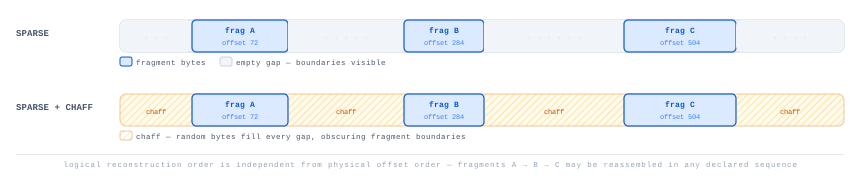
Hidden-state data is embedded into the carrier according to the selected carrier profile and layout strategy.
A state-specific reconstruction object identifies the relevant payload spans, reassembly order, cryptographic instructions, and secret material needed to reconstruct one hidden state.
Datamorpho does not deny that hidden states exist. Hidden states are declared, not hidden in a deniable sense.

For developers
Developers, security researchers, and implementers usually need more than the public explanation. The protocol is designed around layered resistance, deterministic reconstruction semantics, and open technical documentation.
Examples
Datamorpho is easiest to understand through practical examples. Each example should include the base file, Datamorphed file, public manifest, reconstruction object, and expected output.
A visible image containing a later reconstructable hidden state.
A visible text file with a Datamorpho envelope and reconstructable hidden content.
A visible PDF with one or more later reconstructable alternate document states.
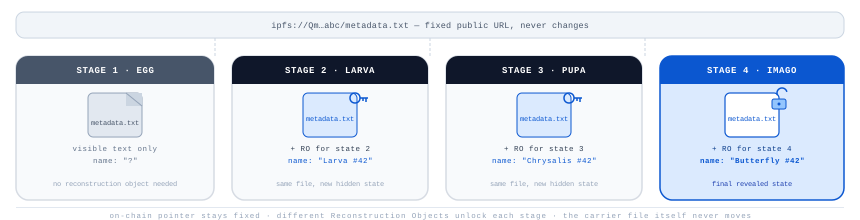
A Datamorphed JPEG and Datamorphed metadata file working together without moving the public metadata location. A natural fit for NFT-style assets and on-chain pointer patterns where the public metadata URL must stay fixed.
Open protocol
Datamorpho is being developed as open infrastructure. The goal is not only to publish a specification, but to maintain a reusable protocol, open-source tooling, free documentation, public examples, and free web utilities that benefit the broader ecosystem.
The normative structure of the format is public and inspectable.
Reference tooling is intended to remain open source and collaboration-friendly.
Datamorpho.io is intended to offer free create and reconstruct flows, plus an optional MorphoStorage helper that the protocol never depends on.
Roadmap
Datamorpho is currently in the open specification and first tooling phase. The next layers are implementation maturity, browser compatibility, and broader carrier support.
Community
Datamorpho is an open technical project. Review the specification, join discussions, open issues, and help shape the future of multi-state file infrastructure.
Source code, documentation, and collaborative development. View on GitHub →
Protocol questions, design conversations, and community review. Open Discussions →
Project updates, releases, and public communications. Follow on X →
For serious inquiries, collaborations, or media questions, write to g@evvm.org.